Last updated: 13 July 2026
Most retail traders in the UK have heard of EUR/USD, GBP/USD and USD/JPY. Far fewer have heard of the US Dollar Index - despite it being one of the most important tools professional traders use to understand what is actually happening in the currency markets. If you trade Forex, or you are thinking about starting, understanding this trade weighted dollar index is one of the fastest ways to improve how you read the market.
This article explains what the Dollar Index actually is, why it matters, and how experienced traders use it to inform decisions across multiple currency pairs rather than looking at each pair in isolation.
What is the US Dollar Index?
The US Dollar Index, commonly known by its ticker symbol DXY, measures the value of the US dollar against a basket of six major world currencies. It was originally developed by the Federal Reserve in 1973, using a starting value of 100 as the baseline. When the index reads above 100, the dollar is stronger than it was in 1973. When it reads below 100, the dollar is weaker. The index is administered today by ICE Data Indices, and futures tracking it trade for 21 hours a day.
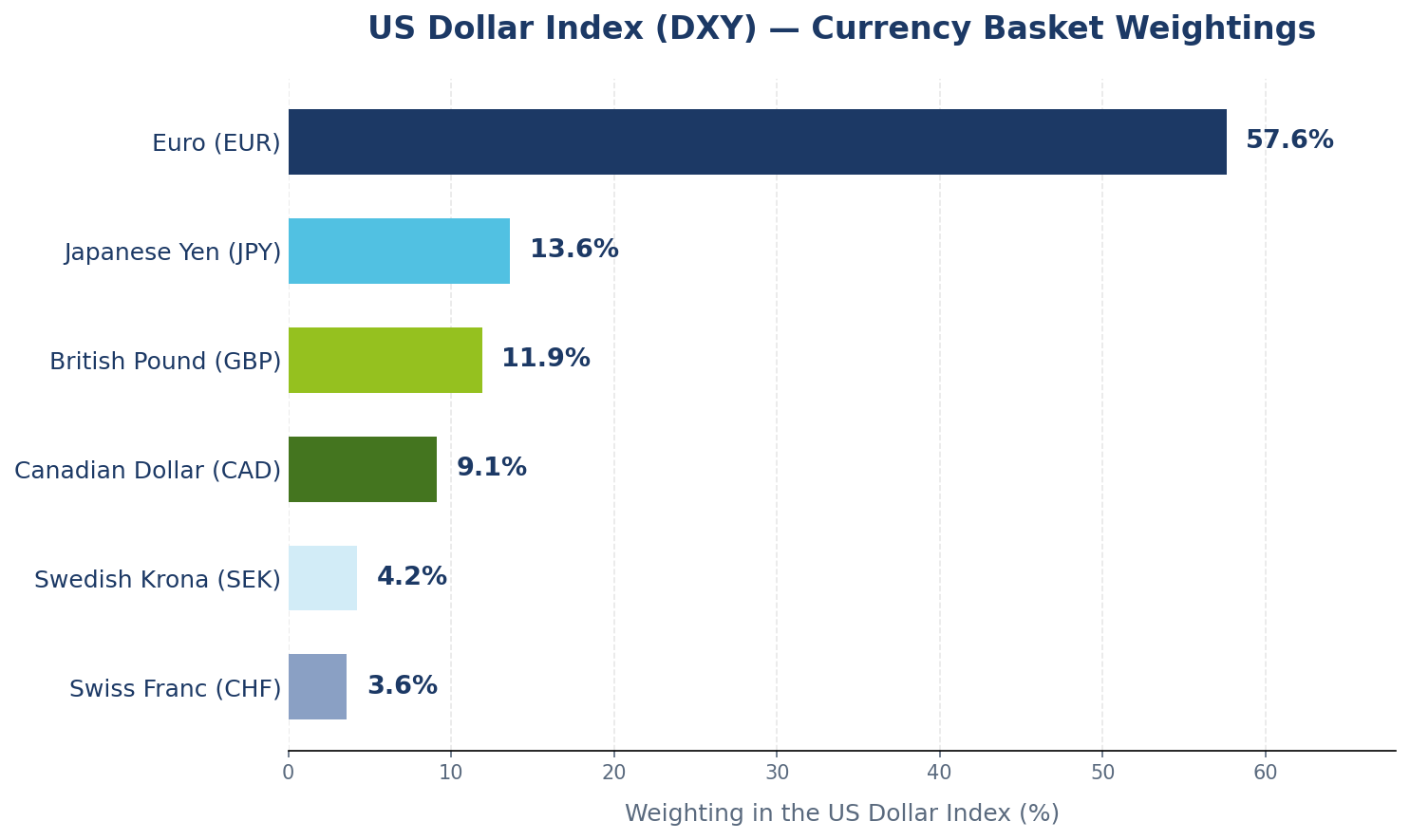
The six currencies in the basket, and their weightings, are:
Euro (EUR) - 57.6% weight
Japanese Yen (JPY) - 13.6% weight
British Pound (GBP) - 11.9% weight
Canadian Dollar (CAD) - 9.1% weight
Swedish Krona (SEK) - 4.2% weight
Swiss Franc (CHF) - 3.6% weight
The Euro dominates the basket, making up more than half of the entire index by weight. This means the Dollar Index is, in practical terms, heavily influenced by what is happening in EUR/USD. But it also captures broader dollar sentiment that individual pairs cannot show on their own. A quick look at any US Dollar Index chart makes this concentration obvious - EUR/USD moves and DXY moves tend to mirror each other closely.
Why the Dollar Index Matters More Than Most Traders Realise
Here is the problem the Dollar Index solves. If you only watch GBP/USD, you cannot tell whether a move is being driven by strength or weakness in the pound, or by strength or weakness in the dollar. A rising GBP/USD could mean the pound is genuinely strong. It could also mean the pound is doing nothing much while the dollar weakens broadly against everything.
This distinction matters enormously for how you trade. If the dollar is weakening across the board - against the euro, the yen, the pound, the Canadian dollar, all at once - that tells you something important about broad market sentiment, US monetary policy expectations, or risk appetite. It is a different trading environment to one where the pound specifically is being driven higher by UK-specific news.
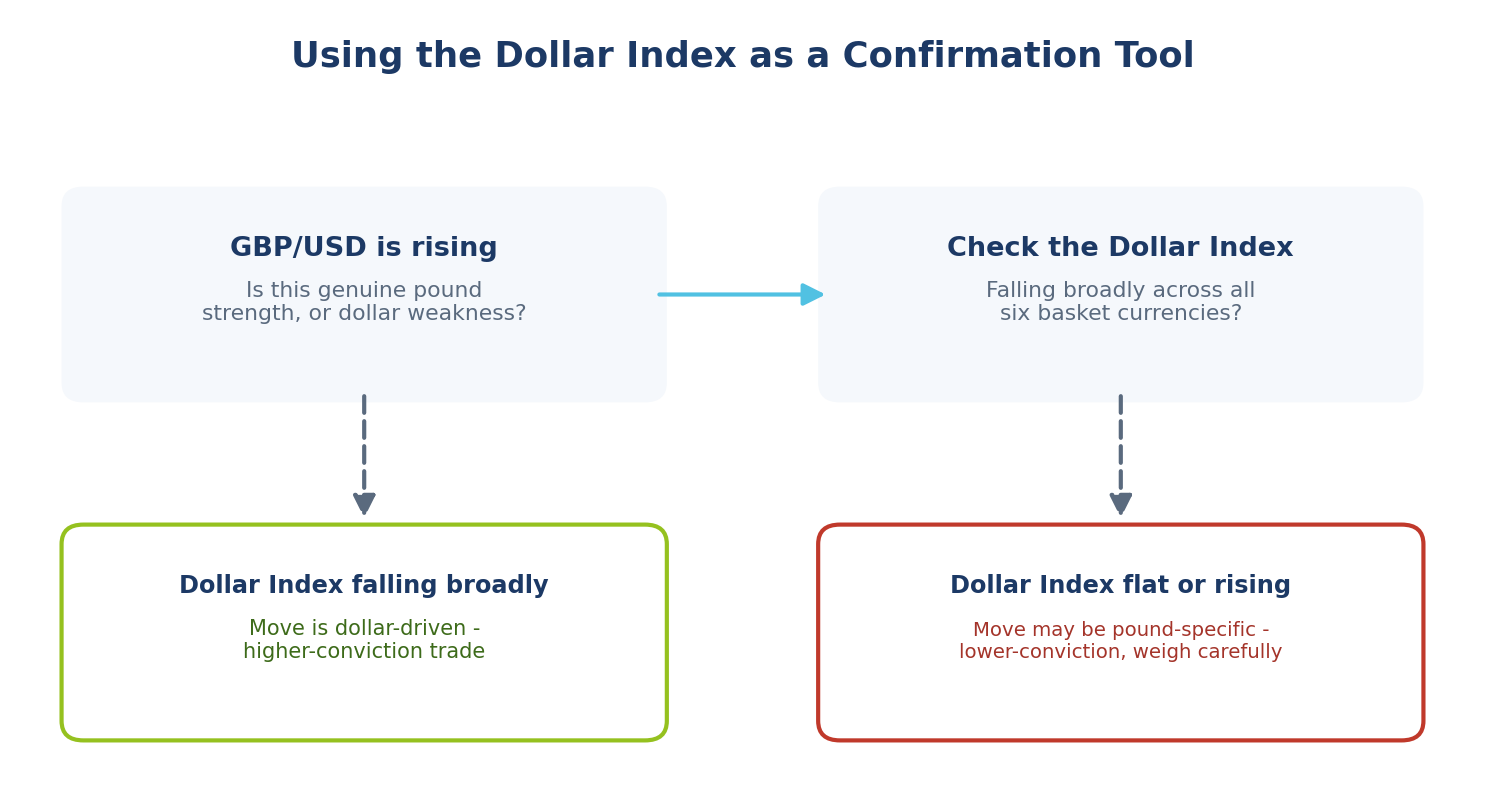
Professional traders use the Dollar Index as a filter. Before taking a position in any dollar-based pair, they check what the Dollar Index is doing. If they want to go long GBP/USD, and the Dollar Index is showing broad dollar weakness across all six currencies, that adds confidence to the trade - the move is being driven by something bigger than just sterling strength. If the Dollar Index is showing dollar strength while GBP/USD is still rising, that is a warning sign - it suggests the pound is moving against the broader trend, which is a harder, less reliable trade to hold.
What Drives the Dollar Index
Understanding what moves the Dollar Index helps you anticipate rather than just react to currency market moves. The main drivers are:
US Federal Reserve policy
Interest rate decisions and expectations are the single biggest driver of the Dollar Index. When the market expects the Federal Reserve to raise interest rates, the dollar typically strengthens because higher rates attract capital seeking better returns. When rate cuts are expected, the dollar typically weakens. Traders watch Federal Reserve meeting minutes, speeches from Fed officials and the Federal Reserve's H.10 foreign exchange rates release closely because they all feed into rate expectations.
US inflation data
Inflation readings directly influence what the market expects the Federal Reserve to do next. Higher than expected inflation typically increases expectations of rate hikes, which tends to strengthen the dollar. Lower than expected inflation does the opposite.
Risk sentiment and safe-haven demand
The US dollar is considered a safe-haven currency. During periods of global uncertainty - geopolitical tension, financial crises, unexpected shocks - capital often flows into the dollar as investors seek stability, regardless of what is happening in the US economy specifically. This is why the Dollar Index can strengthen even when US economic news is not particularly positive.
Relative economic performance
Since the index measures the dollar against a basket of other currencies, it is really about relative strength. If the Eurozone economy is struggling while the US economy is performing well, the Dollar Index tends to rise - not necessarily because the dollar is doing brilliantly, but because the euro (57.6% of the basket) is underperforming.
How Traders Actually Use the Dollar Index
As a confirmation tool
The most common use of the Dollar Index is confirming whether a move in a specific currency pair reflects genuine strength or weakness in that currency, or whether it is simply dollar-driven. This helps traders distinguish between high-conviction setups and lower-quality ones. Some traders refer to this use of the Dollar Index as a dollar strength index check - a quick filter applied before committing to any dollar-based trade.
For correlation trading across multiple pairs
Because six major currencies feed into the index, movements in the Dollar Index tend to correlate with movements across multiple dollar pairs simultaneously. Traders watch the Dollar Index to get a sense of what is likely to happen across their entire portfolio of dollar-based positions, rather than analysing each pair from scratch.
For technical analysis on a cleaner chart
Individual currency pairs can be noisy, particularly pairs involving smaller economies where local news creates sharp, unpredictable moves. The Dollar Index, being an average across six currencies, tends to produce cleaner, more technically reliable chart patterns. Many traders apply their technical analysis to a US Dollar Index chart first to establish the broader dollar trend, then apply that context to individual pairs.
To trade the index directly
Beyond using it as an analytical tool, the Dollar Index itself can be traded directly through CFDs and spread betting with FCA-regulated UK brokers. This gives traders direct exposure to broad dollar strength or weakness without having to choose a specific currency pair.
Currencies Not in the Dollar Index - What This Means
One detail that surprises many traders is what is missing from the Dollar Index. There is no Chinese Yuan, despite China being the world's second-largest economy and a major US trading partner. There is no Australian Dollar or New Zealand Dollar, both heavily traded currencies. This is because the index composition was last meaningfully updated in 1999, when the Euro replaced several legacy European currencies in the basket, and has not been revised since despite significant shifts in global trade patterns.
This means the Dollar Index is not a perfect measure of dollar strength against the entire world - it is specifically a measure against a basket weighted toward the currencies that mattered most to US trade in the late 20th century. Experienced traders understand this limitation and use the Dollar Index alongside other measures rather than relying on it exclusively.
Free Live Session
See the Dollar Index Applied to Live Forex Trades
Join our free Intraday Live Trading Session and watch how our traders use the Dollar Index alongside GBP/USD, EUR/USD and other major pairs to identify high-probability setups in real time. Free to attend - no obligation.
How to Start Reading the Dollar Index Yourself
If you want to start incorporating the Dollar Index into your own trading, here is a simple starting framework. You can follow the live index level yourself at any time through a real-time quote page such as Yahoo Finance's US Dollar Index tracker.
Check the trend. Is the Dollar Index in a clear uptrend, downtrend, or trading sideways? This tells you the broader dollar context before you look at any individual pair.
Compare it to the pair you are watching. If you are looking at GBP/USD, check whether the Dollar Index is moving in the opposite direction (which would explain a GBP/USD move as dollar-driven) or whether it is not moving much at all (which would suggest the move is genuinely pound-driven).
Watch it around major US data releases. Federal Reserve meetings, US inflation data (CPI) and US employment data (Non-Farm Payrolls) are the events most likely to move the Dollar Index sharply. Watching how the index reacts to these releases builds an intuitive understanding of dollar sensitivity over time.
Use it as a filter, not a standalone signal. The Dollar Index is most powerful as a piece of context that improves your confidence in trades on individual pairs - not as a signal to trade on its own without further analysis.
Free Live Session
Learn Currency Analysis the Structured Way
Join our free Swing Live Trading Session and see how a structured, rules-based approach to Forex works across longer timeframes - including how broader dollar sentiment feeds into trade decisions. Free to attend - no obligation.
Why Most Retail Traders Never Learn This
The Dollar Index is not complicated. It is simply underused because most retail traders are introduced to Forex through individual currency pairs and never taught to look at the bigger picture. Free trading content tends to focus on simple setups for a single pair because that is easier to teach and easier to sell. Understanding the relationship between the Dollar Index and the pairs you trade requires a slightly more structured approach to market analysis.
This is exactly the sort of detail that separates traders who understand the full picture from those who are only looking at part of it. But it also raises a fair question. Reading this article is one thing. Actually building the habit of checking the Dollar Index, tracking Federal Reserve policy, watching six currencies at once and applying all of it consistently to every trade is another thing entirely - and for most people, it takes a genuinely significant amount of time to get right.
Where Trendsignal Fits
Here is the honest reality. Everything covered in this article - the Dollar Index, correlation across currency pairs, Federal Reserve policy, technical analysis on a cleaner chart - is genuinely useful to understand. But learning to track and interpret all of it yourself, on top of everything else that goes into trading properly, takes months of study and plenty of expensive mistakes along the way. Most people who try to build this knowledge alone end up doing exactly what the FCA data shows - spending real money learning lessons that a structured programme would have taught them for free.
This is exactly what Trendsignal exists to solve. Rather than spending months learning to read the Dollar Index, monitor correlations across six currencies and interpret Federal Reserve policy yourself, our rules-based strategy already does this analysis as part of every signal our traders act on. You do not need to become a market analyst to benefit from market analysis. Our coaching team - Stuart Hopkins, Head Coach, with over 35 years of experience trading and investing in the markets, alongside Adrian Buthee, our Lead Trading Coach, and Thomas Heal, Professional Trader - has already built this thinking into a structured approach that our members follow, rather than each person having to rebuild it from scratch on their own.
That is really the difference proper trading education makes. It is not just about being taught information you could technically find yourself. It is about not having to spend the time, the money and the trial-and-error figuring out how to combine everything into a working approach. We have been recognised as Best Trading Education Provider 2026 at the London Trader Show Awards and winner of multiple ADVFN Awards for trading education, built on exactly this kind of structured approach since 2003.
The easiest way to see what this looks like in practice is to join one of our free live trading sessions, where you can watch this analysis applied to real markets in real time rather than trying to piece it together yourself.
Frequently Asked Questions
See Professional Forex Analysis in Action
Join a free live trading session and watch how our traders use tools like the Dollar Index alongside individual currency pairs to build genuine confidence in every trade. No obligation - just genuine trading education from a team that has been doing this since 2003.
Intraday Live Trading Session Swing Live Trading SessionAbout Trendsignal: Trendsignal has been providing UK trading education since 2003, based at The Innovation Centre, Cranfield University Technology Park, Bedfordshire. Our trading courses cover Forex, Stocks, Indices and Commodities and include full education in risk management, trading psychology and market analysis alongside our proprietary rules-based strategy. Recognised as Best Trading Education Provider 2026 at the London Trader Show Awards and winner of multiple ADVFN Awards for trading education.
Risk Warning: Spread betting and CFDs are complex instruments that come with a high risk of losing money rapidly due to leverage. Between 70% and 79% of retail investor accounts lose money when trading these products with FCA-regulated providers. Trading these instruments may not be suitable for all investors.